Lens spacing and field of view
Open this interactive explorer through a web server to use its controls. Figure 1.18 remains the static reference.
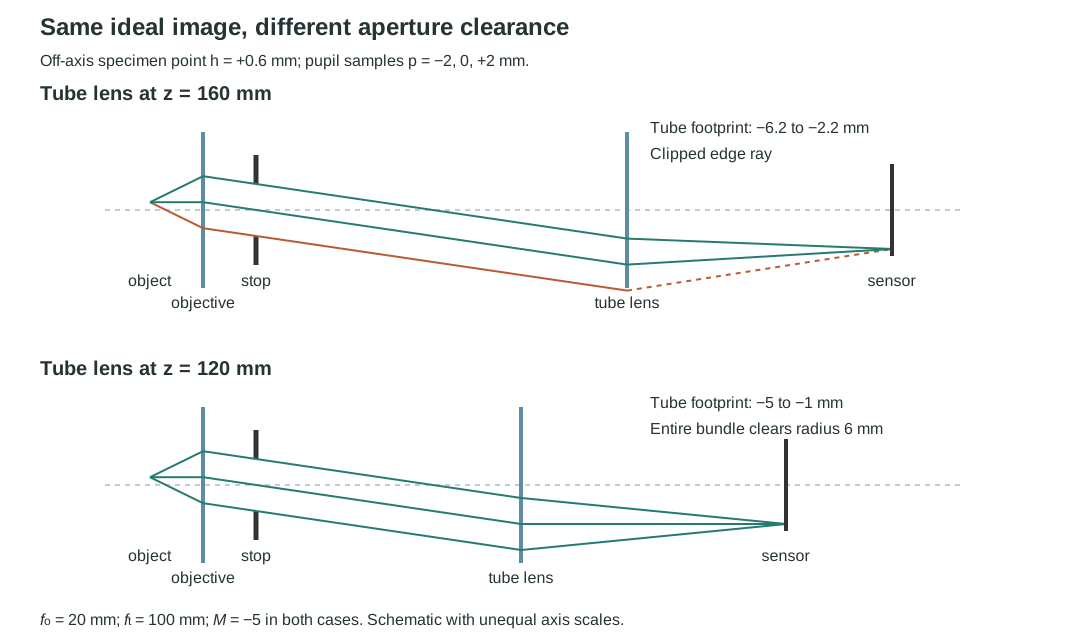
Explore: lens spacing and field of view
Move the tube lens and sensor together. How much of the sensor-covered field clears the optics?
Fixed schematic axes: z = −20 to 280 mm; x = ±12 mm. Axial and transverse scales differ. Solid rays pass; dashed rays terminate at the tube-lens rim. The thick ray is the chief ray.
Hatched regions: sensor-covered but partially vignetted; recorded, but fail the no-clipping requirement.
Drag the object-point marker or use the object-height slider. All field widths are in object space. M = −5 at every spacing; the sensor stays 100 mm after the tube lens. Ideal thin lenses, reference focus, circular apertures; no diffraction or aberrations. Drawn ray counts are not power fractions.