Two waves and one detector
The static interference reference remains available below. To use the interactive controls, enable JavaScript and open this page through a web server rather than file://.
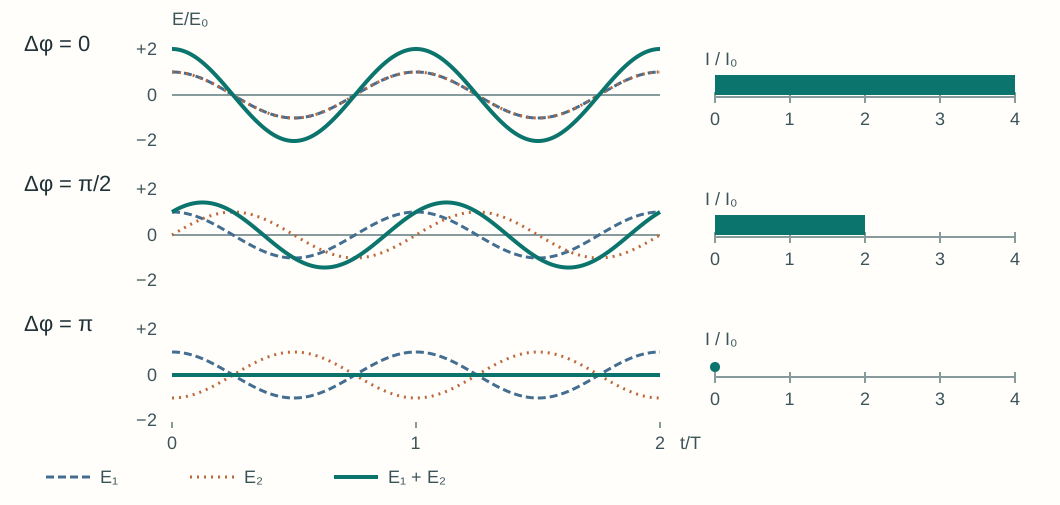
Explore: two waves and one detector
Keep the first wave fixed. Predict how the amplitude and relative phase of the second wave change the detector reading.
At one point in a common transparent medium: two co-propagating plane waves with the same frequency and polarization. Field units are relative to the first wave’s peak amplitude E₁; intensity units are relative to its intensity I₁.
The detector averages over optical cycles while the relative phase stays fixed.
Signed electric fields at one observation point
Wave 1 · solidWave 2 · dashedField sum · thick
Two optical periods are shown; this is a static time trace, not an optical-speed animation. A negative field is a direction of the electric field, not negative intensity.
Optical-cycle-averaged detector intensity
- Separate intensity sum / I₁
- Interference term / I₁
- Detected intensity / I₁
All axes stay fixed as you change the controls. Field scale: −3 to +3 E₁. Intensity scale: 0 to 9 I₁. The detector bars show averaged intensity, not an instantaneous squared field or total beam power.